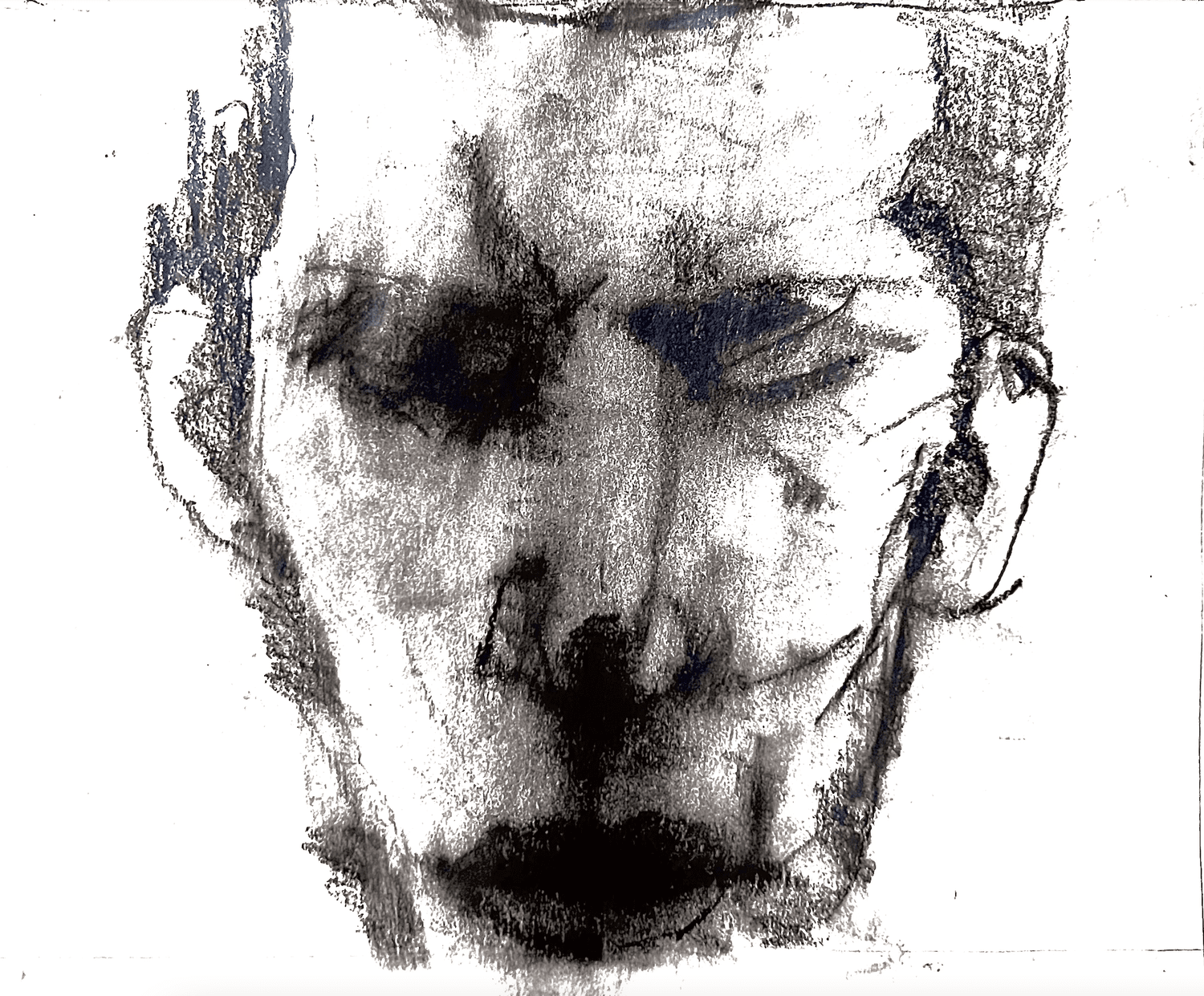
An Entangled Argument for Non-violence
2023
Between December 18th and 28th in 1995 the Hubble Space Telescope aimed its lenses on a densely dark and seemingly empty patch of sky. What it found within that darkness was the opposite of empty…approximately 3,000 galaxies emerged from the images, which became known as the “Hubble Deep Field” images. In 2003 another round of images were taken, and with the advancements in technology from within that dark and unremarkable pinhole in the night sky 10,000 galaxies emerged, with each galaxy being home to millions upon millions of stars.
When you look at the moon, you’re seeing the moon 1.5 seconds in the past as the light reflected from its surface travels from there to here. You are looking back in time. The closest star other than our own sun, Alpha Centauri, emits light that travels four years from there to here. The light from the stars captured in the Hubble Deep Field traveled billions of years from there to here. It’s possible that many of the objects captured within the Hubble pictures no longer exist. And more recently with the James Webb telescope we humans can see even more of these details, of what has happened at different eras across an expansive area of space.
Astrophysicist and BBC TV presenter Brian Cox regularly surmises that alien life could exist, though he assumes they’d likely not have interest in our spec of galactic dust. Other astrophysicists posit that Jupiter would be of greater attraction. In 2017 two scientists identified 10 possible exoplanets where aliens could potentially train their own telescopes to focus on earth. If aliens did have these forms of technology, and somehow found our planet within their own dark patch of sky, they’d be looking at our past.
Which reflection of light would have made the journey from here to their exoplanet? Would they witness the light from the Roman Empire beginning its expansion? Would they see the initial formation of the moon? Or the ice age? Could they focus their lenses down even further through the spectrums of light and radio waves, like the James Webb telescope can, and sift through the light, choosing an era to linger on and to study? To dial up and down the light shaft, going forward and backwards in time like scrolling forward and backwards through a video.
(The Voyager 1 spacecraft, launched on September 5th, 1977, is still in service. It’s racing its way out of the heliosphere and into interstellar space. The light from earth takes 22 hours, 28 minutes and 34.9 seconds to travel from here to there. The Voyager sees your yesterday in its present moment.)
The etymology of the word “heritage” is anchored in the transfer of property from one generation to the next. It’s about what one receives from a predecessor. Most current and popular DNA tests, such as Ancestry.com and 23andMe can only provide data on your heritage that covers the past 6 to 8 generations…or several hundred years. If we created measurement tools based on the utility of heritage, the units would be capped in the hundreds of years.
One of those 10 exoplanets identified as a potential home to life is 200 light years away. If an alien would be looking into their night sky and could see our light, they’d be looking, right now, at the early indicators of your current heritage.
The results of the popular DNA tests enable the users to view an inference about themselves, with a view into the short time frame of their recent heritage. If one seeks data from further back, it becomes increasingly cloudy and inconclusive. We know modern humans have been on the earth for approximately 300,000 years. What can a few hundred years of modestly definable data truly mean? Can a few hundred years of data define anyone’s truth of who they are?
In professor Paul Robert Magoski’s 1993 well-illustrated volume, “The Historical Atlas of East Central Europe,” the reader witnesses landscapes and borders of East Central Europe from above, much like an alien life pointing their telescope onto the earth’s surface. Nations, cultures, ethnicities, and eras shift, blend, fade and emerge incredibly quickly, especially when compared to both heritage (a few hundred years) and the origin of modern humans (300,000 years ago). Nations and nationalities come and go within the scope of decades.
I used one of the popular DNA tests to help me understand who I am. They too could, with some confidence, track my heritage back to the 1700s, but no further. Taking some of the data points from their report, such as the Haplogroup (a cluster of protein on a DNA strand) I did some further research and found a somewhat inconclusive, but a well educated guess, on where “I’m from.” Not surprising, this data isn’t part of my family narrative at all, but maybe it should be. At least it would illustrate that who we think we are now is nothing like who our very recent ancestors thought they were.
The 2022 Nobel Prize in Physics was awarded to a team who identified that one particle in an entangled pair of particles determines what happens to the other in the pair of particles even if that other particle is seemingly too far away to be affected by its partner. This means that one can change the state of a nearby particle and by doing so will also change the state of the far away particle, due to the fact that the far away particle was once entangled with the near particle. This is taking place on the quantum level, invisible to the majority of us.
We could all be unintentionally and invisibly affecting activities on the other side of the universe, out into deep space. An alien life force on one of those potential 10 exoplanets could be taking actions right now at this moment that immediately affect the space around me, and even inside my human form. We could also merely be affecting the particles of our next door neighbors. These particles know no borders, no nations, not even planets or galaxies. They exist, it’s a truth. Your heritage however, it’s not a truth, it’s a blip within the spectrum of light that would likely be unseen by any alien life.
Who were those humans 300,000 years ago, our factual ancestors, gazing across the African landscape? Could they have possibly imagined the shifting and fragile categories and boundaries we current humans have invented? Could they have wished for us, their entirely related grandchildren, the world we inhabit now?
Our DNA data is merely the recent, frayed edges of deeper evidence, but it doesn’t matter. It defines nothing except that we are a fantastic and extraordinary life-from continuing, lasting hundreds of thousands of years. It tells us that we are all actually the same, a cluster of entangled particles affecting each other whether we are near or far.
Look, within the dark patches of the night sky where you see nothing, there isn’t any darkness at all.